Top UX/UI Agencies Specializing in AI Interfaces in 2026

What makes an AI UX design agency qualified to work on an AI product?
This question is likely on the minds of many founders and product leads currently planning to test the potential of an AI-driven idea. According to Figma’s 2025 report on artificial intelligence, 52% of developers building AI-based products believe design is even more critical for these products than for traditional ones.
AI products bring new challenges for UX designers. Users need to understand what AI can do and how to use it effectively. The interface should also make it clear when AI results may be inaccurate or need human review. Otherwise, users may lose trust, and businesses may face legal or ethical risks. Even if an AI product solves a real problem, poor UX can limit adoption and make it harder to achieve product-market fit.
As a result, finding a professional design agency experienced in working with AI products has become a pressing issue. The right team can transform the complex capabilities of AI into intuitive, user-friendly solutions — all while balancing technical constraints, business goals, and user expectations.
But what criteria should you use to assess potential vendors? What exactly should you look for?
If this dilemma sounds familiar, you’ve come to the right place. The Linkup ST team keeps a close eye on the latest trends in AI digital product development and understands the challenges involved in finding a high-quality design partner. That is why we have compiled a list of AI design agencies with the relevant expertise, and we are happy to share it with you. Additionally, we’ve also included insider tips on what to look for while evaluating agencies and key questions to ask before choosing a design partner.
Let’s get started!
Linkup ST
Website: linkupst.com
Founded: 2013
Location: United States, Delaware
Team Size: 80+
Rate: From $60/hr
Key clients: Reverso, TATA, Bosch, Freestone, Impactive
Linkup ST is an AI-driven design agency that creates functional design systems for businesses of many sizes and markets, including SaaS, fintech, healthtech, martech, real estate, and e-commerce. They focus on measurable product outcomes and have hands-on experience designing AI-powered products.
Portfolio includes:
- Element X — AI marketing platform
- SkinSpotter — AI-powered skin monitoring app
- Toto — a platform that helps users create appeals to government officials with AI
Linkup ST brings together UX research, prototyping, and usability testing to really get what users want, what drives them, and where they hit roadblocks. They look closely at how people actually interact with the product. That way, team spots fresh opportunities for useful AI features, make workflows smoother, and catch usability issues early — so you don’t end up redoing work down the line.
As an agency, Linkup ST also ready to handle development ourselves or jump in alongside your dev team to make sure our designs function effectively in real use.
Their end goal in cooperation with clients is AI products built around real user needs, with a focus on adoption, retention, and long-term growth.
Best for: AI startups, SMBs, and established SaaS businesses in need of creating and developing complex, user-facing AI products.

Qubika
Website: qubika.com
Founded: 2006
Location: Texas, USA
Team size: 1100
Rate: $50–99/hour
Key clients: Avant, OnePay, Shopify, MyRow, Tabula Rasa
Qubika is a US-headquartered digital product development company specializing in AI, software engineering, data solutions, and UX/UI design.
Qubika is not a specialized AI UX/UI design agency; however, the company has a dedicated Product Design studio as a separate part of its broader offering that can provide UX research, service design, design thinking, and UX design for AI-powered products. It works across several industries with strongest specializations in fintech/banking and healthtech.
Additionally, Qubika holds SOC 2 Type II and ISO 27001 certifications, alongside with hands-on HIPAA-related requirements experience.
Best for: Established fintech and healthcare companies seeking UX/UI design as part of a broader AI development project.
GojiLabs
Website: gojilabs.com
Founded: 2014
Location: Los Angeles, California, USA
Team size: 70+
Rate: $150–199/hour
Key clients: WWF, KCRW, PredictionStrike, k-ID, Hard Assets Alliance
GojiLabs is a software development agency for enterprise teams that provides design services for high-impact digital products. The range of services includes AI prototyping and rapid validation, IU/UX design, UX audit, usability testing, and UX research. This agency has proven AI-related UX and development work experience in welltech, SaaS, and media markets.
Beyond that, GojiLabs is open to work on projects within e-commerce, Edtech, Fintech, sustainability, logistics, and public sectors. They approach cooperation as a strategy-first partner that brings clarity to complexity.
Best for: Enterprises seeking to build or improve in-house AI projects.
Clay Global
Website: clay.global
Founded: 2009
Location: San Francisco, California, USA
Team size: 70+
Rate: $150–199/hr
Key clients: Meta, Google, Stripe, Slack, Coinbase, Amazon
Clay is a branding and UX design agency, working as a full-service digital innovation partner. Its design cases have earned global recognition through design awards like The Webby Awards, Awwwards, and CSS Design Awards.
The agency cooperates with companies of different sizes — from startups to enterprises — mostly within fintech, crypto & Web3, and e-commerce vectors. Clay’s hands-on experience includes cases of creating interaction design, brand identities, and design systems for AI-powered platforms. It also offers development services for emerging tech (AI, AR/VR), which makes it a potential partner for both product design and implementation.
Clay’s main commitment is to transform brands through elevated digital experiences.
Best for: Fintech companies that aim to develop AI products with both a complex design system and a strong brand identity.
Neuron
Website: neuronux.com
Founded: 2016
Location: San Francisco, California, USA
Team Size: 10-49
Rate: $150–199/hr
Key clients: Vendr, AcuityMD, Listrak, HMH
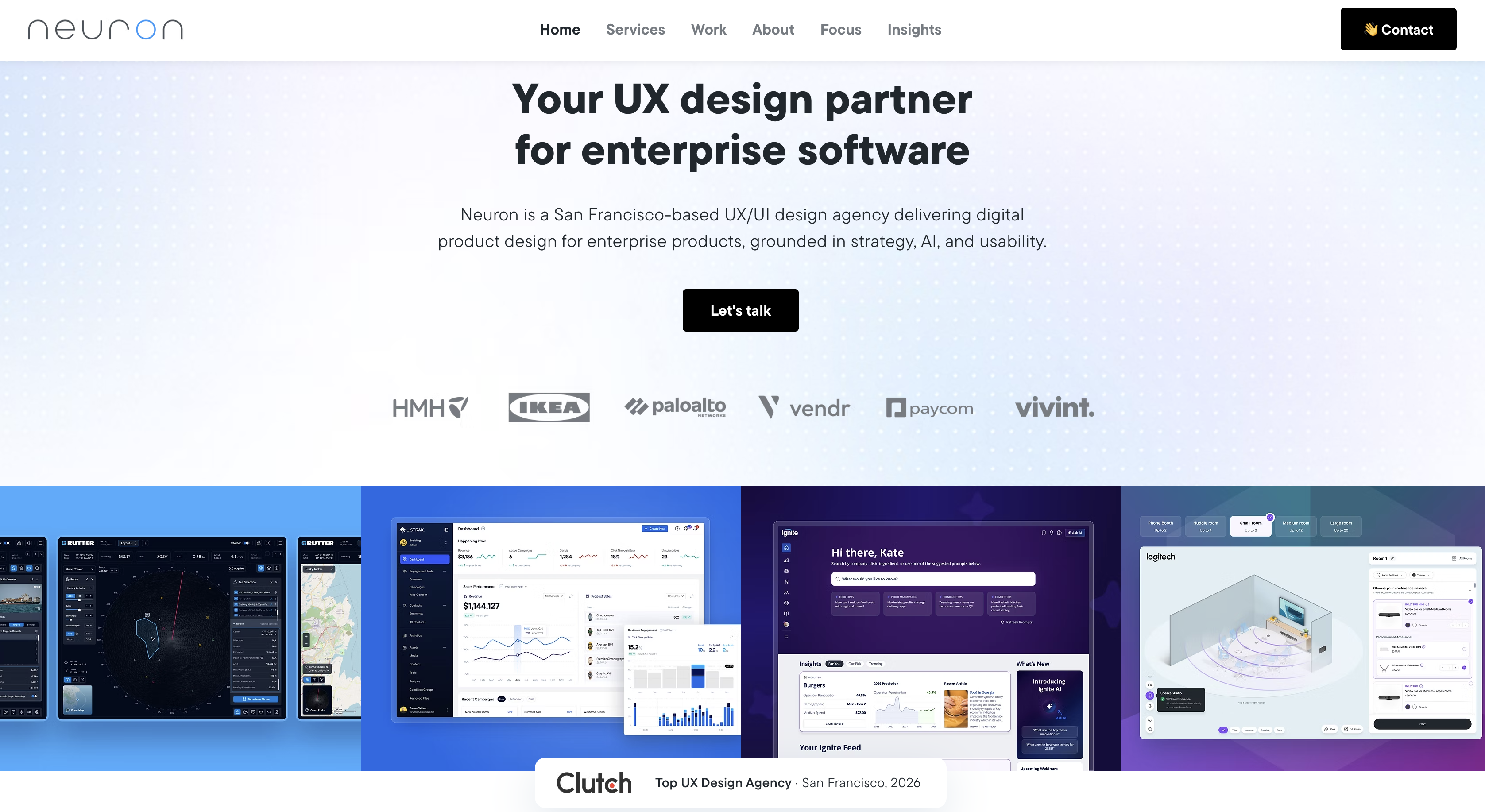
Neuron is a UX/UI design agency for enterprise products built on strategy and usability. Much of the team's work focuses on complex enterprise platforms that support sales, marketing, HR, project management, and financial operations.
Neuron’s portfolio includes case studies that highlight its expertise in developing designs for AI-powered dashboards and AI-assisted analytics systems.
Additionally, the agency has been recognised as a Top User Experience Company by Clutch.
Best for: Enterprises in need of complex AI-powered in-house platforms.
Metalab
Website: metalab.com
Founded: 2006
Location: Vancouver, British Columbia, Canada
Team size: 160
Rate: From $150/hr
Key clients: Midjourney, Uber, Robinhood, Suno, The Atlantic
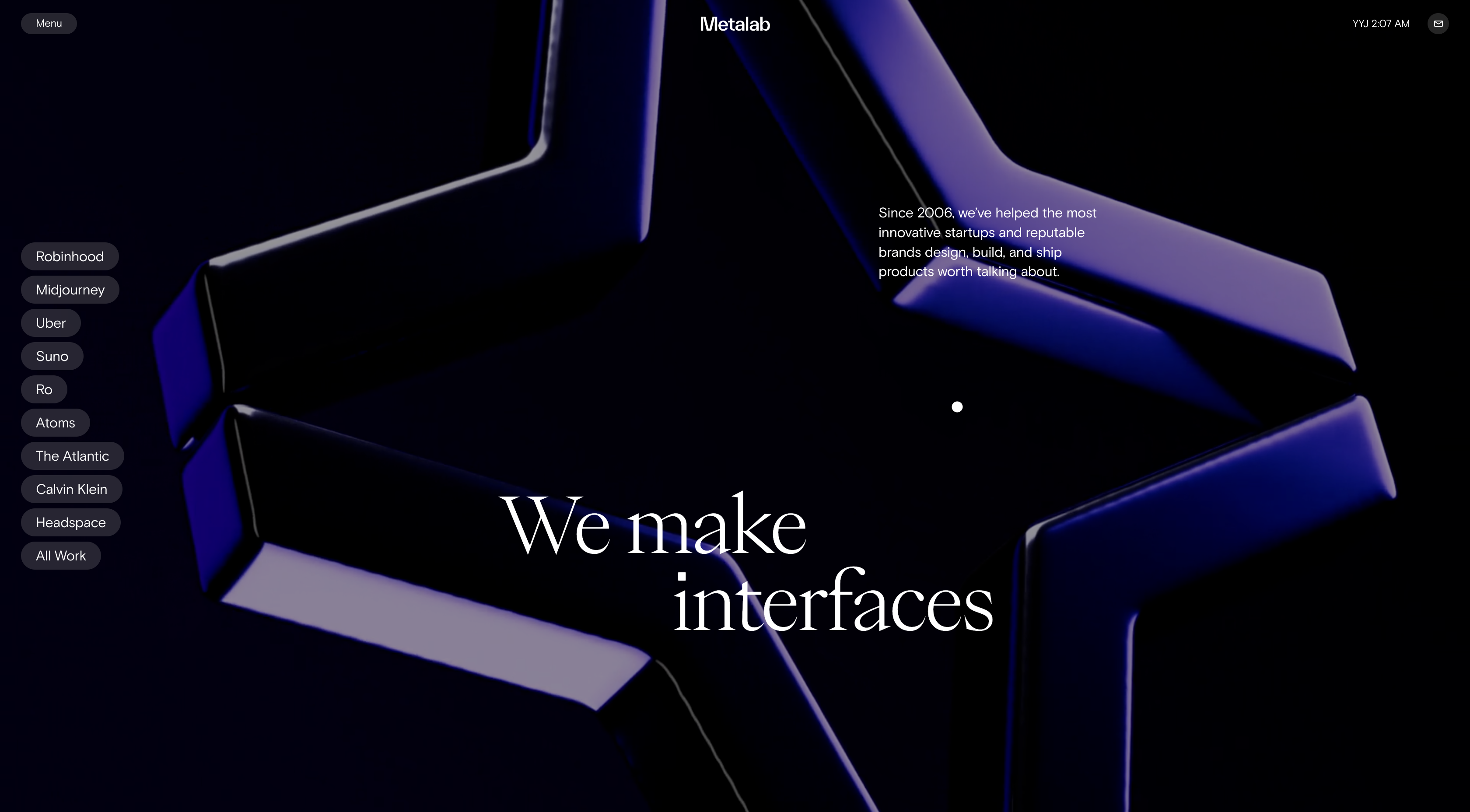
MetaLab is a full-service digital product agency with a committed AI practice. It covers AI product strategy, interface design, and machine learning integration. The team has earned a reputation as a partner for leading tech companies — «you’ve probably used something that we designed» — yet the agency does not limit itself to industry giants and also works with startups. It is a cross-industry company with a notably strong background in fintech, AI, and SaaS domains.
Besides that, Metalab was ranked #7 among the Most Innovative Design Companies by Fast Company in 2026.
Best for: Generative AI startups that plan to introduce complex AI features.
Ideo
Website: ideo.com
Founded: 1991
Location: San Francisco, California, USA
Team size: 500+
Rate: From $200/hr
Key clients: Ford, Sephora, H&M, Moderna, Boom Supersonic
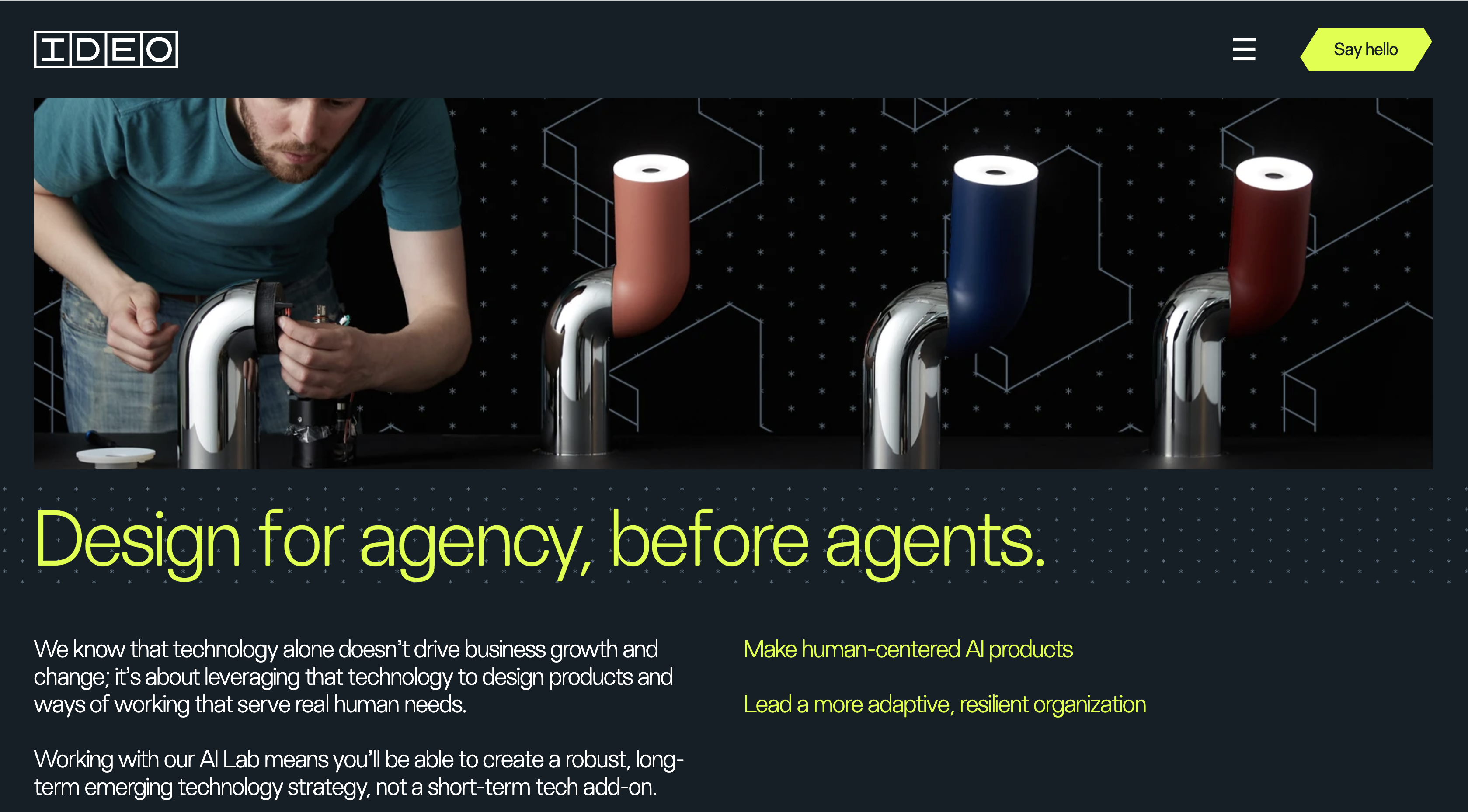
IDEO is a design and innovation company with 35 years on the market. Its services include product strategy, UX research, digital product design, prototyping, and business innovation. The company also has a dedicated AI Lab focused on designing new AI products and integrating AI into existing services.
IDEO’s approach is human-centered — the agency has differentiated itself by putting particular emphasis on user needs, trust, and human control over AI interactions. The team creates designs for digital products across healthtech, retail, transportation, and Edtech markets.
Best for: Edtech and enterprise companies designing AI-assisted products that require strong user research.
frog
Website: frog.co
Founded: 1969
Location: San Francisco, California, USA
Team size: 1000+
Rate: $150–199/hr
Key clients: Unilever, IKEA, Volvo Group, Sanofi, Tiffany & Co.
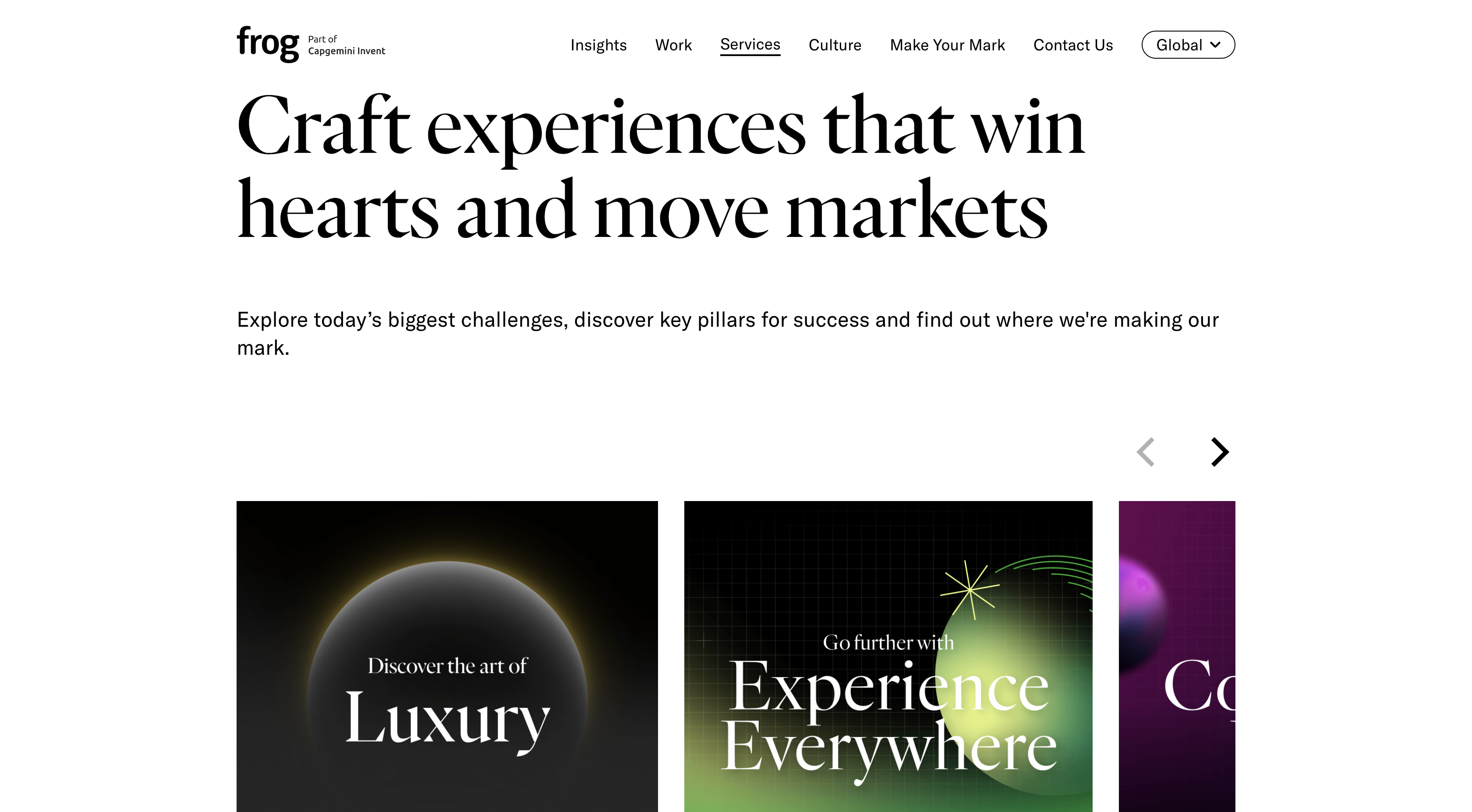
frog is a design and consultancy company, founded in Germany. Today, it operates as part of Capgemini Invent with headquarters in the USA. The company’s portfolio is extensive in technology, consumer products, healthcare, retail, and automotive/mobility. frog's AI experience covers data-heavy analytical platforms, conversational AI assistants, wellness apps, and AI-powered medical devices. Its portfolio also includes generative AI experiences for employee training and retail.
frog positions itself as a reinvention and experience partner. The ultimate goal is to help businesses create new products, improve existing customer experiences, or find opportunities for growth through creative design decisions.
Best for: Companies looking to launch intelligent, connected products that combine AI-powered software, physical devices, and complex user interactions.
Work & Co
Website: work.co
Founded: 2013
Location: Brooklyn, New York, USA
Team size: 400+
Rate: $100–149/hr
Key clients: Apple, Google, Nike, Pfizer, LOEWE
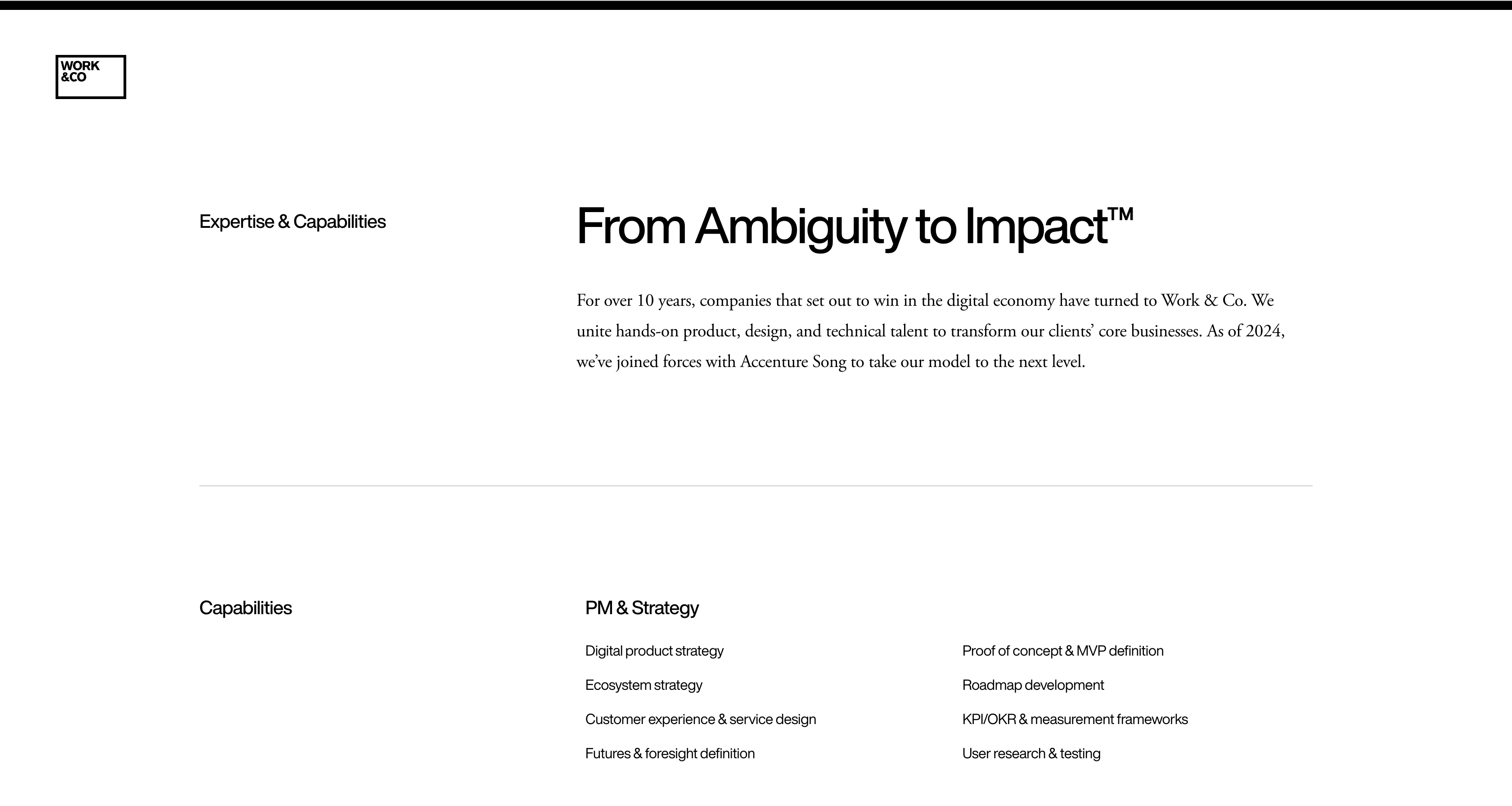
Work & Co — an agency with hands-on product, design, and technical experience. It provides a variety of services, including product vision & conception, digital product strategy, GenAI & multimodal UX, and GenAI implementation strategy.
Among their AI UX-related experience is creating design systems and workflows for conversational AI assistants, intelligent search platforms, personalized recommendation systems, and generative AI tools in healthcare, retail, and B2B markets.
Best for: Businesses that need to integrate conversational AI into customer-facing digital products.
Accenture
Website: accenture.com
Founded: 1989
Location: Dublin, Ireland
Team size: 10,000+
Rate: From $160+/hr
Key clients: Škoda, Siemens Energy, WWF, Bristol Myers Squibb
Accenture is not exclusively an AI UX design agency, but rather a global consulting and technology company specializing in business transformation and software engineering.
Its design capabilities — UX research, service design, digital product and AI-powered customer experience development — are mainly delivered through Accenture Song, a creative division of the enterprise. The company also holds ISO/IEC 27001 certification for information security and ISO/IEC 27701 certification for privacy information management.
Accenture Song has worked on conversational AI interfaces, AI-powered personalized recommendations, and AI feature integration into beauty, retail, and telecommunications platforms.
Best for: Retail companies planning to integrate AI-powered assistants into their existing customer platforms.
Best AI Design Agencies by Industry
Some sectors — like fintech, edtech, and healthtech — really need extra care while designing and developing AI products. And it’s not just because these areas deal with sensitive data. A bad AI decision or even a simple mistake can have serious consequences for people’s finances, health, or education.
That’s why it’s so important to be upfront about how AI works in your product, what it can and can’t do, how people can check or correct its results, what kind of human oversight is involved, and how you protect users’ personal information. These aren’t just nice-to-haves; they actually shape the product’s architecture and the design of different user scenarios.
Companies in these sectors also need to follow relevant regulations. In the EU, these include the EU AI Act, GDPR, European Accessibility Act, and sector-specific rules such as MDR/IVDR and DORA. In the US, key requirements include HIPAA, FDA regulations, and state laws such as California's CCPA/CPRA. Healthcare products may also need to follow the Human Factors Guidance.
What you actually have to do depends on what your product does, what risks are involved, and where you’re selling it. But no matter what, as AI regulations keep evolving, you have to integrate compliance into your whole process — from research and design to testing. Honestly, it pays to take the time and pick an AI design company that knows your industry inside and out.
Here are a few AI UX design agencies with solid experience in finance, education, and healthcare projects.
Best UX Agencies for Fintech AI Design
In fintech, when AI makes mistakes, it can cost people money, cause unfair loan rejections, or block transactions for no good reason.
These risks make clear UX essential. Users need to understand AI-generated decisions, assess financial risks, and know how to correct errors or request human review.
We've selected three AI interface design agencies with solid fintech experience that are worth a look for your next project.
MetaLab
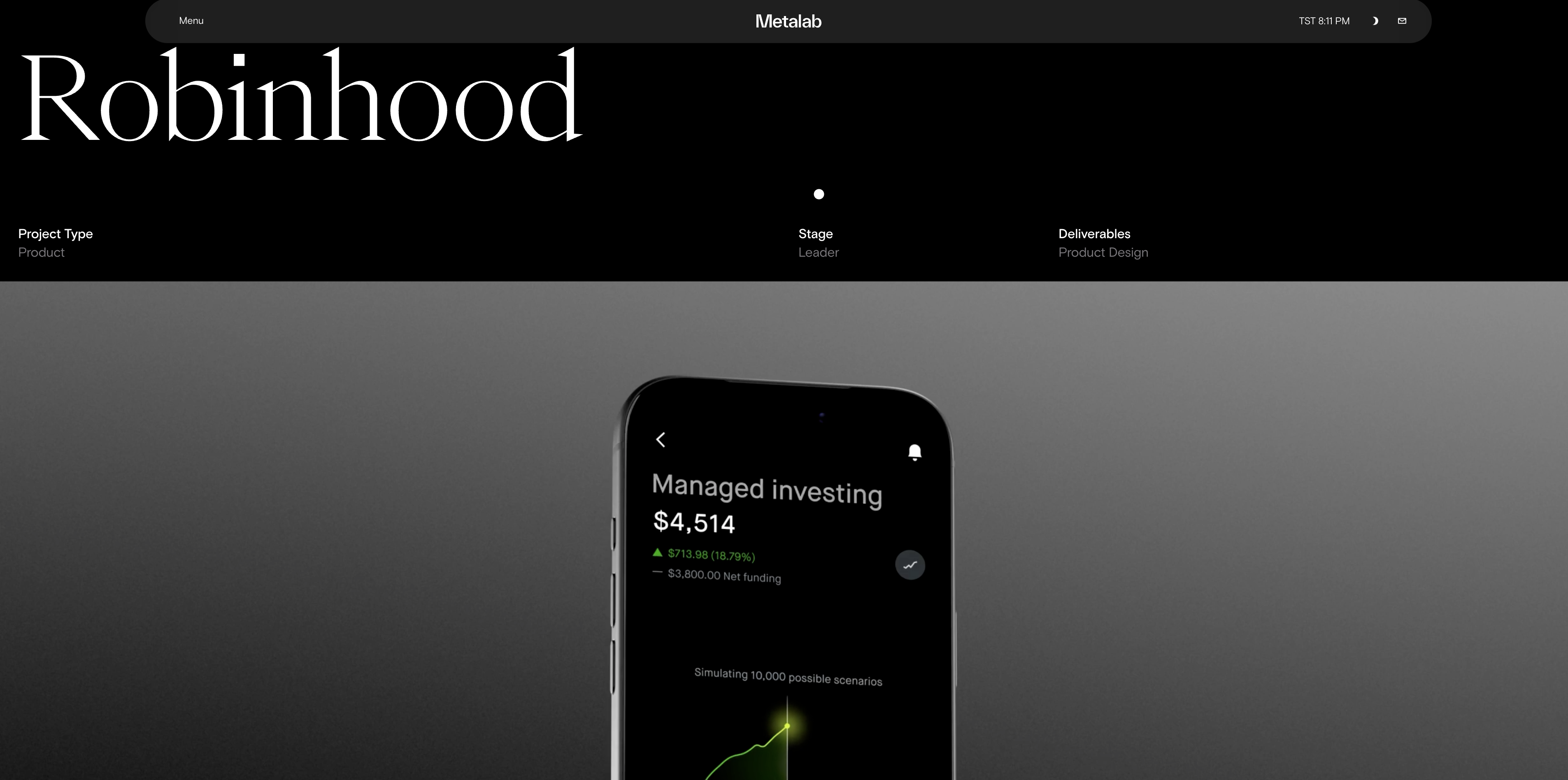
MetaLab combines extensive fintech experience with a dedicated AI product design practice. Its client portfolio includes Robinhood, Nubank, and Wealthsimple, alongside AI platforms such as Midjourney and Suno.
For Robinhood, an investment management product of personalized, expert-managed portfolios, MetaLab developed a new UI framework following Robinhood's rebrand. The team introduced interactive data visualizations, 3D elements, glass-like effects, and subtle animations to make financial information easier to understand while maintaining a consistent visual identity across the product.
This AI UI UX design company is a strong fit for fintech companies looking to add AI-powered insights, personalized recommendations, or conversational features to existing products.
Clay
Clay has extensive fintech experience and has worked with big names like Discover, STC Bank, Grayscale, and Streetbeat. Its projects aren't just limited to one area — they cover digital banking, investment platforms, and financial data visualization.
For example, for Streetbeat, an AI-powered investment platform, Clay redesigned the brand identity and visual system. The team created infographics, icons, and illustrations to present complex investment data more clearly. It also developed a consistent visual language for the product interface, helping users navigate financial information and understand the platform's capabilities.
Clay is particularly relevant to AI fintech companies that need to present complex financial data clearly while building a recognizable, trustworthy product identity.
Qubika
Financial services are one of Qubika's core specializations, with over 20 years of industry experience. Its Finance Studio works with banks, lenders, and payment providers on digital banking, financial infrastructure, credit scoring, fraud detection, and regulatory compliance.
For Avant, a US consumer lending company, Qubika developed machine learning models to assess creditworthiness using credit bureau reports and transaction data. The company reports 10× faster ML predictions. Its work with OnePay also demonstrates experience in mobile banking UX, app development, and product analytics.
For fintech companies comparing AI design agencies, Qubika offers financial industry expertise alongside AI engineering, UX/UI design, and secure software development.

Best UX Agencies for Healthcare AI Design
Healthcare AI products cater to a range of users and group needs something different from the user experience, whether that's clear, understandable medical info or safe, smooth workflows that support clinical care.
When picking an AI product design agency, focus on teams that know healthcare inside out, understand how to protect sensitive data, and stay on top of industry rules.
Here are some agencies you should have on your radar.
Linkup ST
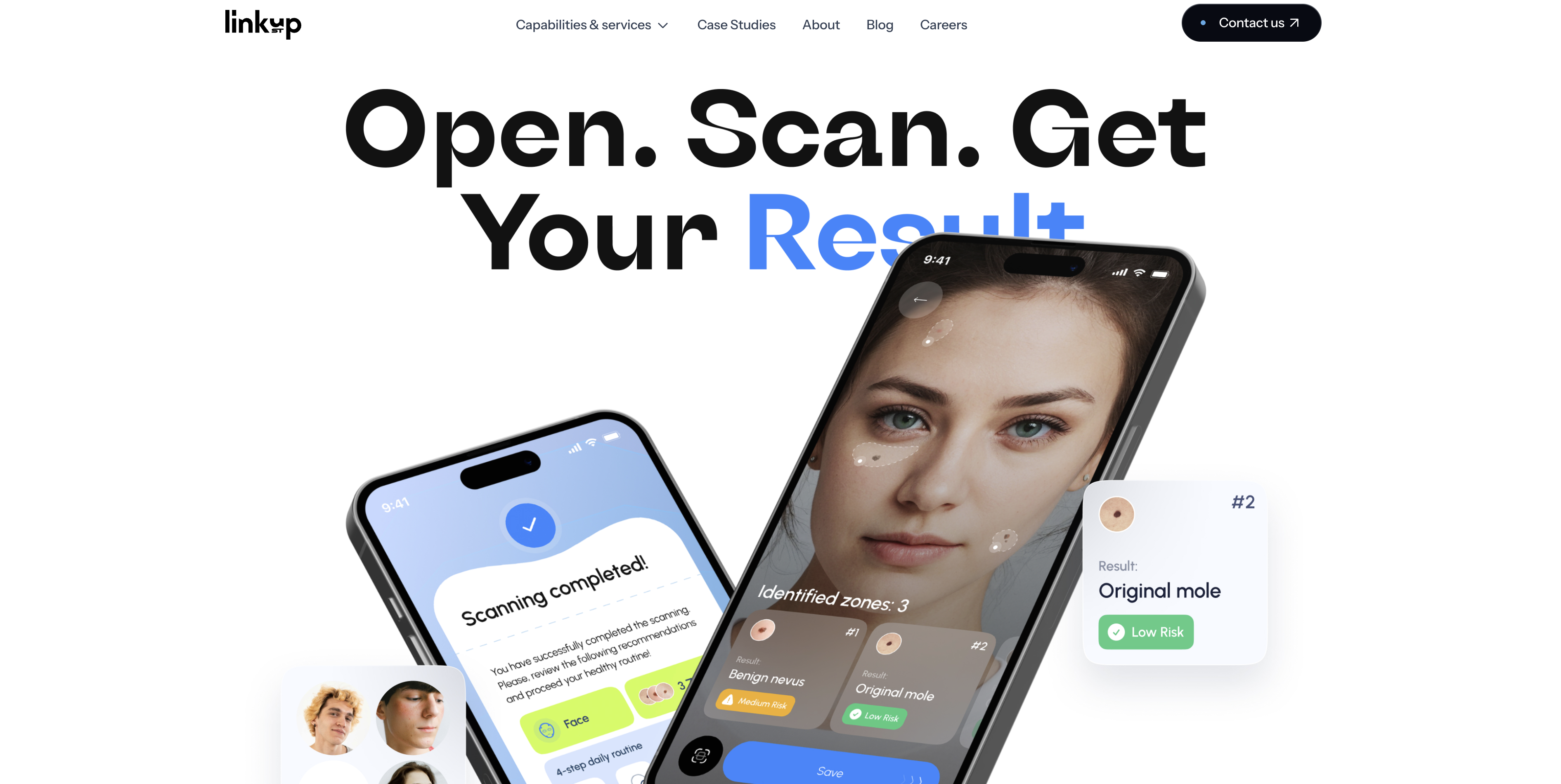
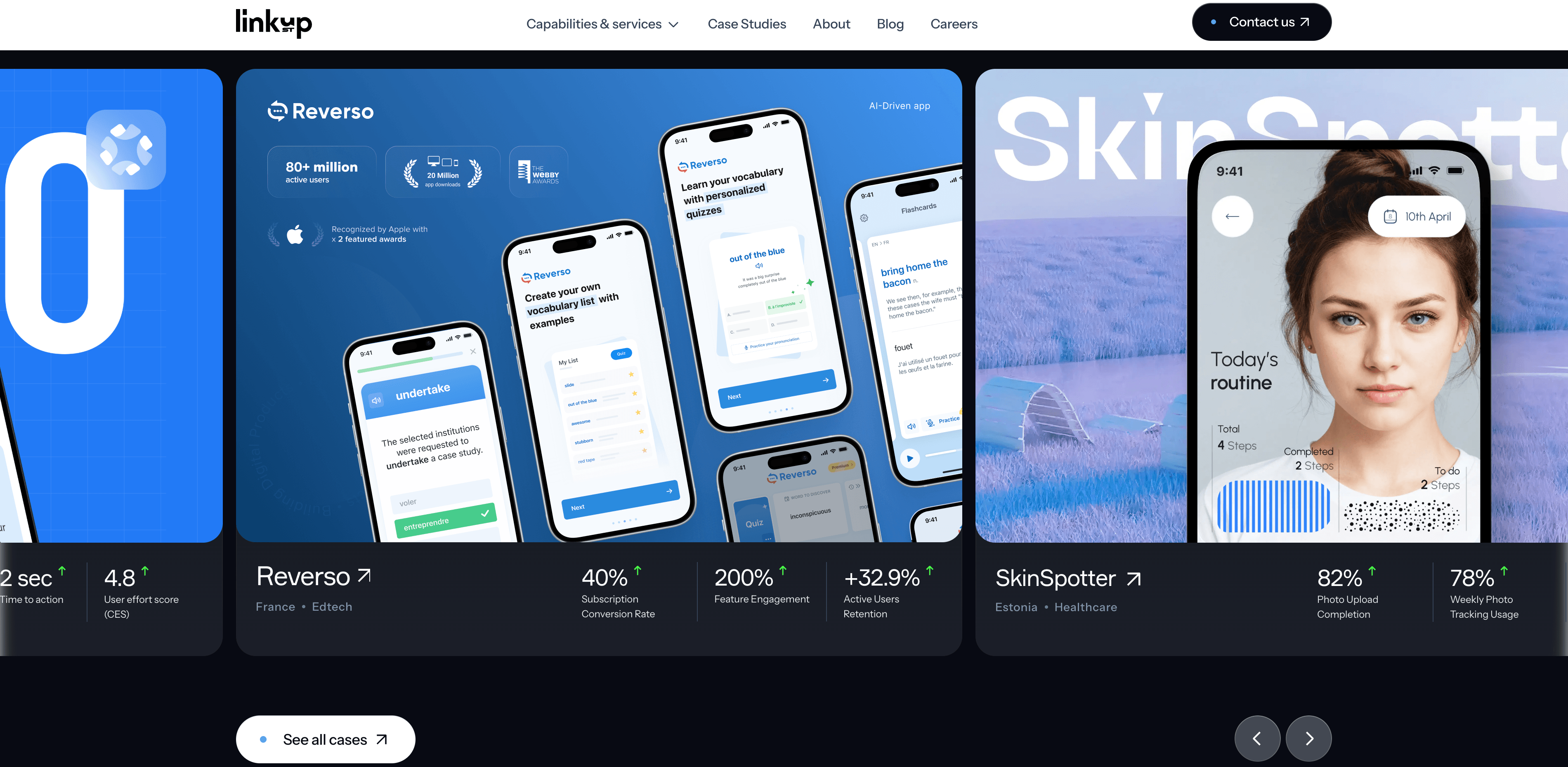
Working with SkinSpotter, Linkup ST designed photo uploads, body mapping, symptom tracking, and reminders for monitoring skin changes. It reports 82% upload completion and 78% weekly tracking during testing and early use.
This makes Linkup ST a relevant choice for patient-facing apps focused on easy onboarding and continued use.
frog
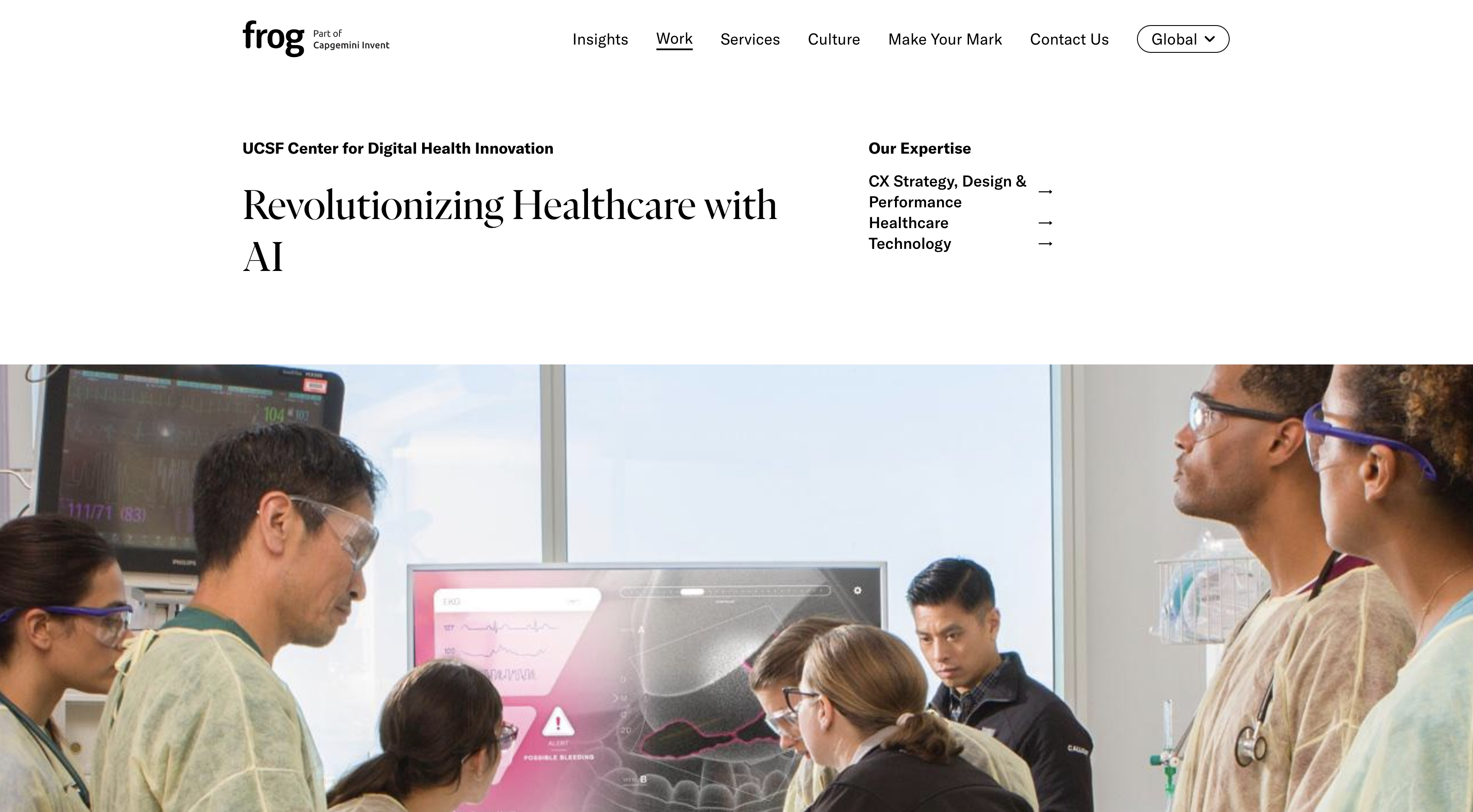
In urgent care, clinicians need to spot critical information quickly. For UCSF’s SmarterHealth, frog worked with clinicians on a concept interface for an AI-enabled trauma center, reducing on-screen information to limit overload.
frog is worth considering if you need to communicate a complex clinical concept and align stakeholders before development.
Lazarev.agency
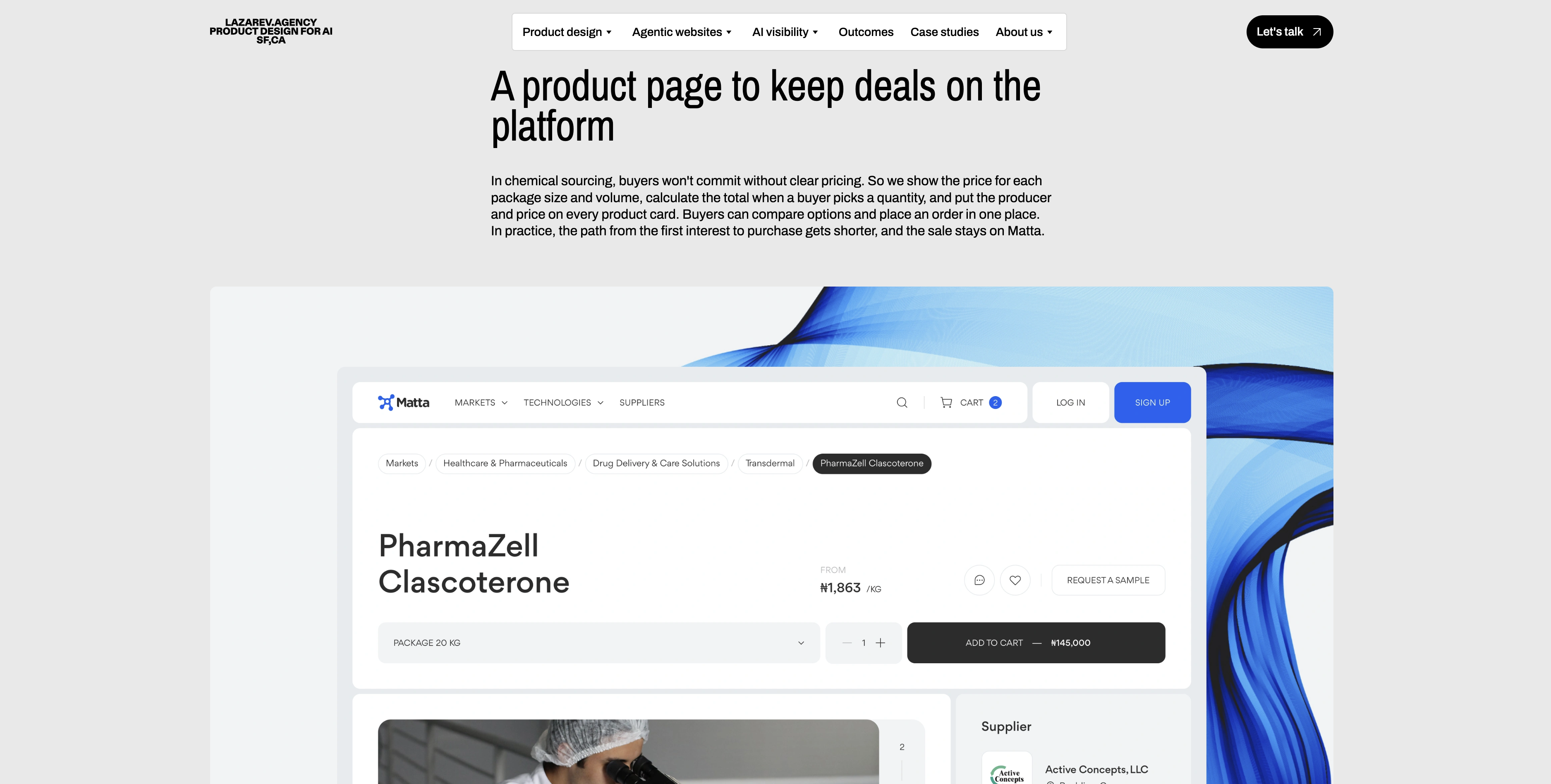
Lazarev.agency's healthcare design services focus on creating personalized, easy-to-use digital experiences.
For WellSet, a wellness platform, the team improved navigation, content discovery, and progress tracking. The agency reports a 75% increase in engagement and a 30% improvement in retention.
Lazarev.agency is worth considering for wellness platforms focused on usability and user retention, although its AI design experience needs further verification.
Best UX Agencies for Edtech AI Design
Edtech products need more than engaging lessons. Their UX must help learners discover useful tools, stay motivated, and move between tasks without friction. These agencies address these product challenges.
Linkup ST
If learners overlook useful features, Linkup ST's work on Reverso is worth examining. After identifying low adoption of its paraphrasing tool, the team improved button visibility and added an animated feature preview. Linkup ST reports a 200% increase in feature usage and 35% growth in premium subscriptions.
This makes the agency relevant to established edtech apps looking to improve feature adoption and conversion.
Lazarev.agency
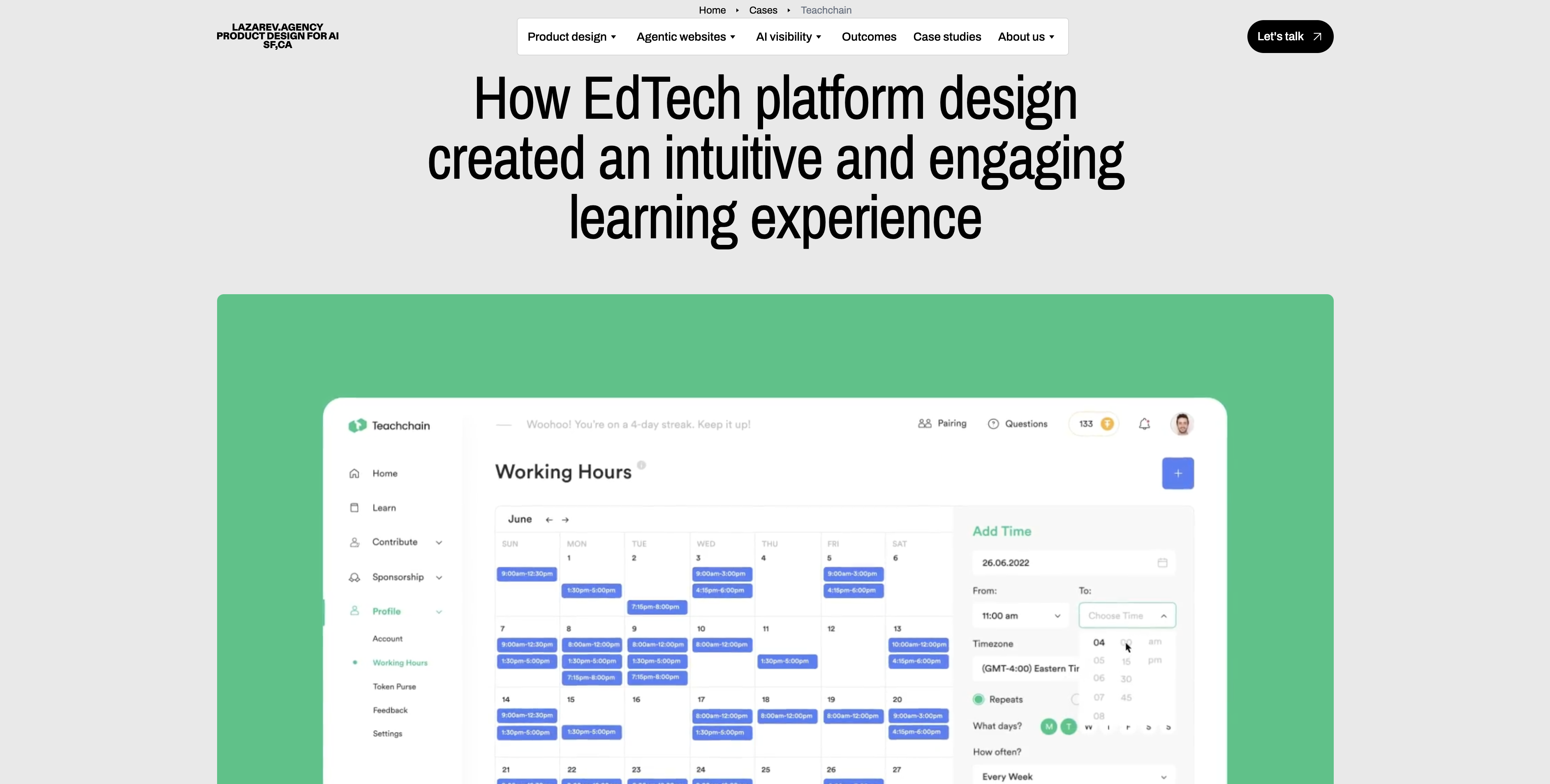
Teachchain needed to connect students, course creators, and sponsors on one platform. Lazarev.agency designed content publishing and review workflows, student progress tracking, and dashboards for managing sponsorships.
Its experience is particularly useful for multi-sided learning platforms with complex user roles, although the case does not confirm AI-specific design work.
Spaceberry Studio
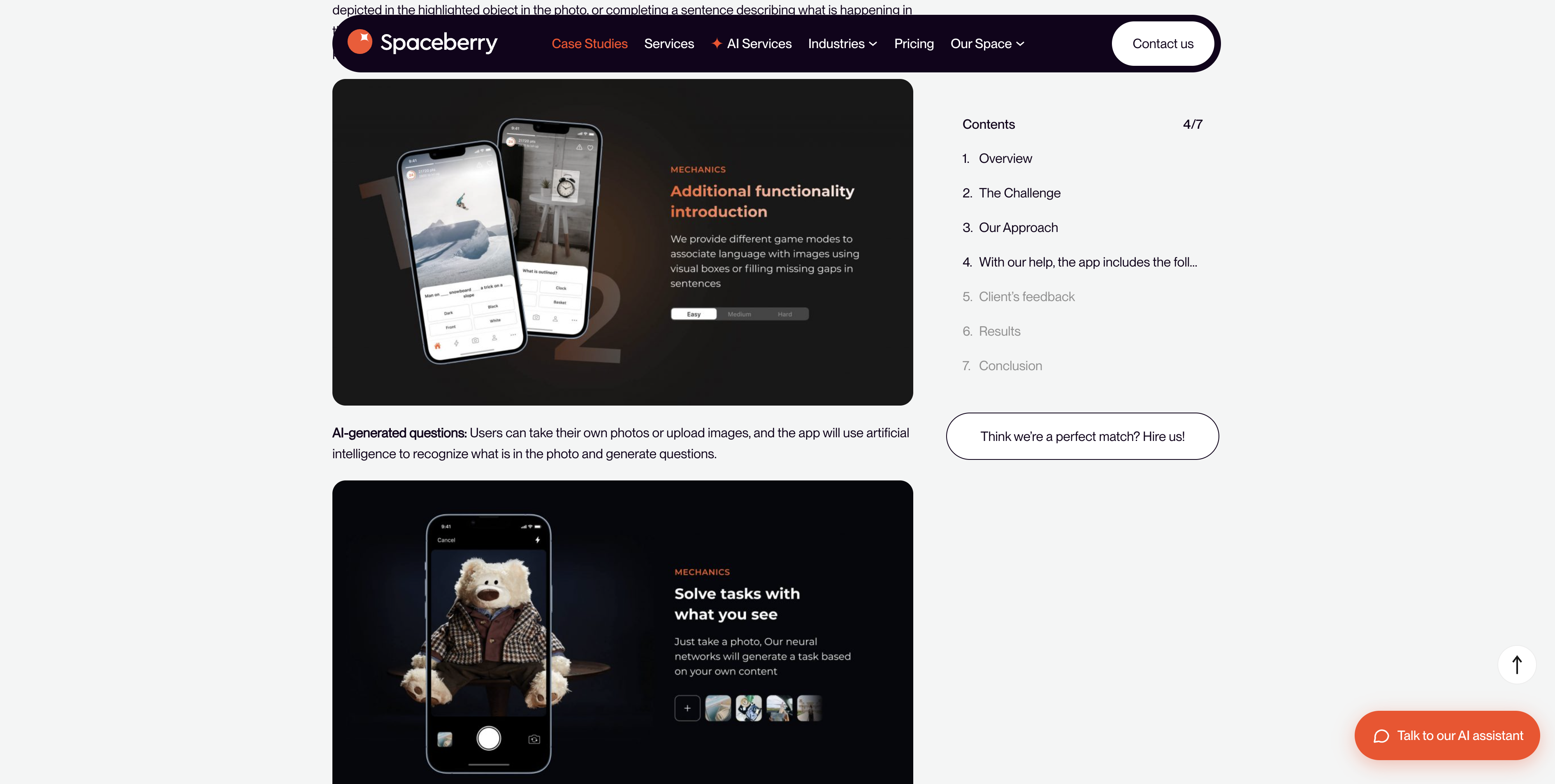
AI-generated exercises need to be easy to use and engaging enough for regular practice. For PickLang, Spaceberry designed a mobile experience that turns users' photos into AI-generated language exercises. Its work covered guided onboarding, personalized tasks, swipe navigation, and gamified progress tracking.
A relevant choice for edtech startups developing mobile AI learning tools that need intuitive interactions and repeat engagement.
How to Choose an AI Design Agency in 2026
Not every AI product design agency is right for every project. A small startup launching its first AI feature has a totally different set of priorities than a huge enterprise wrestling with complex, regulated systems.
So how do you sort through your options? It comes down to matching the agency to your own unique situation: where your product is in its lifecycle, how technically demanding your requirements are, what your budget really allows, and, honestly, what your current team just doesn’t have the skills for yet.
Keeping all that in mind, here are six things to pay attention to if you want to choose the right partner among AI UX design agencies. Think of this like a checklist — it’ll help you focus on what matters most and find a team that actually fits your needs.
1. Evaluate Their Strategic Business Acumen
For a successful partnership, look for firms that deeply understand your target audience and precisely how artificial intelligence can uniquely drive ROI. Top UX agencies specializing in AI design solve real-world market problems for your customers and understand your core business goals.
2. Check for Proven AI Interface Experience
The ideal partner must have a verifiable, proven track record in AI product design. Ask for detailed case studies demonstrating exactly how they have transformed generative AI tools or machine learning algorithms into user interfaces that drive adoption.
3. Assess Their Approach to Data and Security
Compliance: Ensure the agency adheres to strict security protocols (SOC 2, GDPR).
Transparency: The best agencies design user flows that prioritize consent.
Safety: This is particularly crucial if you operate in heavily regulated industries like healthcare or finance.
4. Understand Their Prototyping and Testing Agility
AI products and models evolve at breakneck speeds. Your design partner should employ highly iterative prototyping – look for teams that can quickly pivot based on real-time feedback. They should minimize technical debt and accelerate your product's shipping to market.
5. Look for Human-Centered Ethical Design
As AI capabilities expand rapidly, ethical design becomes a critical differentiator. A premier agency ensures the AI's decision-making processes are understandable – avoiding frustrating "black box" scenarios that can alienate your base.
6. Analyze Communication and Collaborative Fit
The synergy between your internal engineering team and the external design agency dictates the overall success of the project. Prioritize partners who actively act as an extension of your company: clear communication channels, shared project management tools, and aligned cultural values are essential for a smooth workflow.
Key Questions to Ask Before Hiring an AI/UX Design Agency
A good portfolio tells you what an agency has designed. But how do you know if the team understands the challenges of AI products?
Start with their past projects. Look at how they've tackled UX issues, handled AI’s limitations, and tested their design choices. You want evidence they’ve actually built AI-powered products, not just played around with AI tools.
These six questions will give you a good read on what you can expect from any design partner you're considering, so you know you're not just picking a team with pretty visuals, but one that actually gets the nuts and bolts of AI product design.
1. How do you design for incorrect or uncertain AI responses?
AI sometimes gets things wrong: it might misinterpret what you’re asking, generate false data, or use limited evidence to generate answers. Since these problems aren't always obvious to users, the interface needs to help them assess the results and decide what to do next.
Ask the AI interface design agency to show you real examples of how they deal with situations like these in actual projects. For instance, using source references helps users double-check any claims the AI makes. And if the system can’t get the data it needs, it should just tell users about the limitation instead of giving an answer it can’t support.
Also, find out how the agency tests these solutions. Do users recognize when an answer needs verification? Can they correct mistakes without restarting the task?
A strong agency should be able to explain its design decisions and demonstrate how they help users avoid errors, complete tasks, and make informed decisions.
2. What happens when users need to undo an AI action?
Imagine an AI assistant updating hundreds of customer records in a CRM. If it changes the wrong information, users should be able to see what was modified and correct mistakes without reviewing every record manually.
Ask the AI UI UX design agency how it handles these situations. For example, before-and-after comparisons help users identify changes, while version history and rollback options make it easier to restore previous data.
However, not every action can be reversed. Users should confirm actions that are difficult to undo, affect sensitive information, or have significant consequences. For example, an AI agent should request approval before sending emails to customers, deleting records, or initiating financial transactions. In contrast, routine actions that are easy to reverse may not need additional confirmation.
The agency should explain how it balances automation with user control, including when to request approval, what information to show before an action, and how users can recover from mistakes.
3. When should AI act independently, and when should users approve its actions?
Not every AI action needs approval. Automatically organizing notes carries less risk than sending customer emails or changing payment details.
An experienced AI UI UX design company should know how to adjust user controls based on the risks involved. For example, an AI agent might prepare several updates automatically but ask for approval before applying them to a customer database.
When reviewing the agency's work, check whether users can see what the AI plans to do, which information it will change, and whether they can edit or cancel the action.
The important question is how the team decides where human approval is necessary. This is especially relevant for enterprise software, where automated mistakes can affect multiple departments, customers, or business processes.
4. How do you decide what AI should explain to users?
More information doesn't always mean better transparency. Users rarely need to understand the technical details of a model. They need enough context to decide whether its output is useful and reliable.
For example, an AI-powered investment platform might explain which market data influenced a recommendation, when that data was updated, and what risks users should consider.
When evaluating AI interface design agencies, ask how they decide which details to show immediately and which to make available on request.
Look for examples of source references, clear explanations, and designs that distinguish facts from AI-generated suggestions. A capable team should also explain how it checks whether users understand this information.
After all, an explanation has little value if people still misinterpret the recommendation or trust it more than they should.
5. How do you test AI interfaces beyond the ideal scenario?
A prototype may look convincing when the AI responds correctly. But what happens when a request is unclear, the model takes too long to respond, or an external service stops working?
Reliable AI product design firms should test these situations before development is complete. Ask how the agency works with engineers to simulate failed requests, incomplete results, and unexpected model behavior.
It's also worth discussing the team’s measures of usability. Task completion rates, correction frequency, and time spent recovering from errors can help reveal problems that visual reviews won't catch.
Rather than accepting general claims about extensive usability testing, ask for an example of a problem discovered during validation and how the team changed the design to address it.
6. How will your team work with our developers and existing product?
Even a well-designed interface can become expensive to implement if it ignores technical requirements. AI products introduce additional considerations, including response times, API limitations, access permissions, and changes in model behavior.
An AI-powered UI UX design company should account for these factors before handing designs over to developers. For instance, the team should document loading states, failed actions, approval flows, and what users see when an AI feature is unavailable.
When comparing AI UX agencies, ask how their designers collaborate with engineering teams, document complex workflows, and handle changes during development.
This matters especially if you're adding AI to an existing product. The new features must work with your current design system and business processes rather than creating separate workflows that are difficult to maintain.
What should you take away from their answers?
You don't need an agency to have a perfect solution for every scenario. What matters is whether the team can explain its decisions, discuss the trade-offs, and support its approach with real examples.
A reliable AI design company should be able to show not only what it designed, but also why it made certain decisions, how the product was tested, and what changed as a result.
Ultimately, these conversations will tell you more about a potential partner's expertise than another collection of polished interface screenshots.
Conclusion: Finding the Right AI Product Design Agency
A great portfolio gets your foot in the door, but it doesn’t show you how an agency tackles the unique challenges your product faces. If you’re serious about comparing agencies, pick a couple that really know your industry, then throw the same real scenario from your product at them during your intro call.
Analyze how they break down the challenge, spot any risks, and describe their testing strategy.
Moreover, don’t just rely on their design samples. Ask if they’re comfortable with your tech stack, and check if their approach can scale and keep things manageable as your product grows.
Their answers will give you a much clearer idea of what it’s actually like to partner with them.
Got an AI product idea or need to upgrade your current one? Reach out and let’s talk through your UX challenges.
At Linkup ST, we’re ready to help you hit your business goals.