
No More CDs: How We Built YU-Med – A SaaS Platform with a "Heavy" DICOM Viewer and a Secure Ecosystem
.webp)
Transitioning from Physical Media to Cloud Medicine
Imagine a standard situation: a patient gets an MRI, CT, or ultrasound, and the diagnostic center hands them the results on a physical CD. In today's reality, this creates absurd problems – and the idea was to digitize this process fully.
On the Ukrainian market, there are medical systems (like Helsi) where you can view text-based lab results, but they lack the ability to work with "heavy" visual data.
This is how the YU-Med project was born – a comprehensive SaaS platform accessible via mobile apps (for patients and doctors) and a web version (for clinics and administrators). It is a product designed to turn a doctor's smartphone into a fully-fledged diagnostic tool.
.webp)
Impact at a Glance
- Zero Physical Media: 100% elimination of CDs/DVDs for diagnostic result delivery.
- Streamlined Workflow: Reduced administrative overhead by automating doctor verification via Diia API.
- Rapid Access: Instant DICOM visualization with multi-planar reconstruction (MPR) and PET/CT fusion capabilities directly on mobile devices.
- Granular Security: 100% user-controlled data access with time-limited permissions and full audit trails for every patient record interaction.
- Gamified Growth: Organic user acquisition via a referral system with a 72-hour invitation window, driving subscription conversion.
.webp)
.webp)
Breaking Free from the CD Era
The project was initiated to address two primary inefficiencies in the medical landscape. First, the traditional use of physical media like CDs and DVDs for sharing diagnostic results is both inconvenient and outdated for modern healthcare workflows. Second, while the Ukrainian market has existing systems for text-based results, there was a significant lack of solutions capable of handling "heavy" DICOM visual data on mobile devices, preventing doctors from using their smartphones as effective diagnostic tools.
.webp)
A Clinical-Grade DICOM Experience
Mobile DICOM Viewer
The main innovation of the project was the ability to work with the specific medical DICOM format without being tied to a desktop computer. This is not just an "image viewer," but a serious clinical tool.
To optimize the client's budget, we used a powerful open-source library (OHIF) and seamlessly integrated it into a native mobile app. Thanks to integration with cloud servers (via the DICOMweb API), we implemented functionality unique to the mobile market:
- Multi-Planar Reconstruction (MPR): A doctor can view scans simultaneously in axial, sagittal, and coronal projections with crosshair synchronization. Simply put, bones can be rotated like a 3D model.
- PET/CT Fusion: The ability to combine CT anatomical data with PET metabolic data by adjusting layer transparency.
- Clinical Measurements: Tools for precise measurements (length, angles, etc), drawing Regions of Interest (ROI), and leaving annotations. All this data can be easily exported to CSV/JSON formats – for medical reports.
- Real-time Manipulation: Adjusting brightness, contrast (Window/Level), and zooming without losing performance on a smartphone.
"It was critical for doctors to be able to not just look at an image, but fully work with it: outline problem areas, change perspectives, and do it from their phone from anywhere," notes Danylo Tsiupiak, Business Analyst at LikupST.
Role Ecosystem
For seamless data exchange, the platform's functionality is distributed among three main types of users:
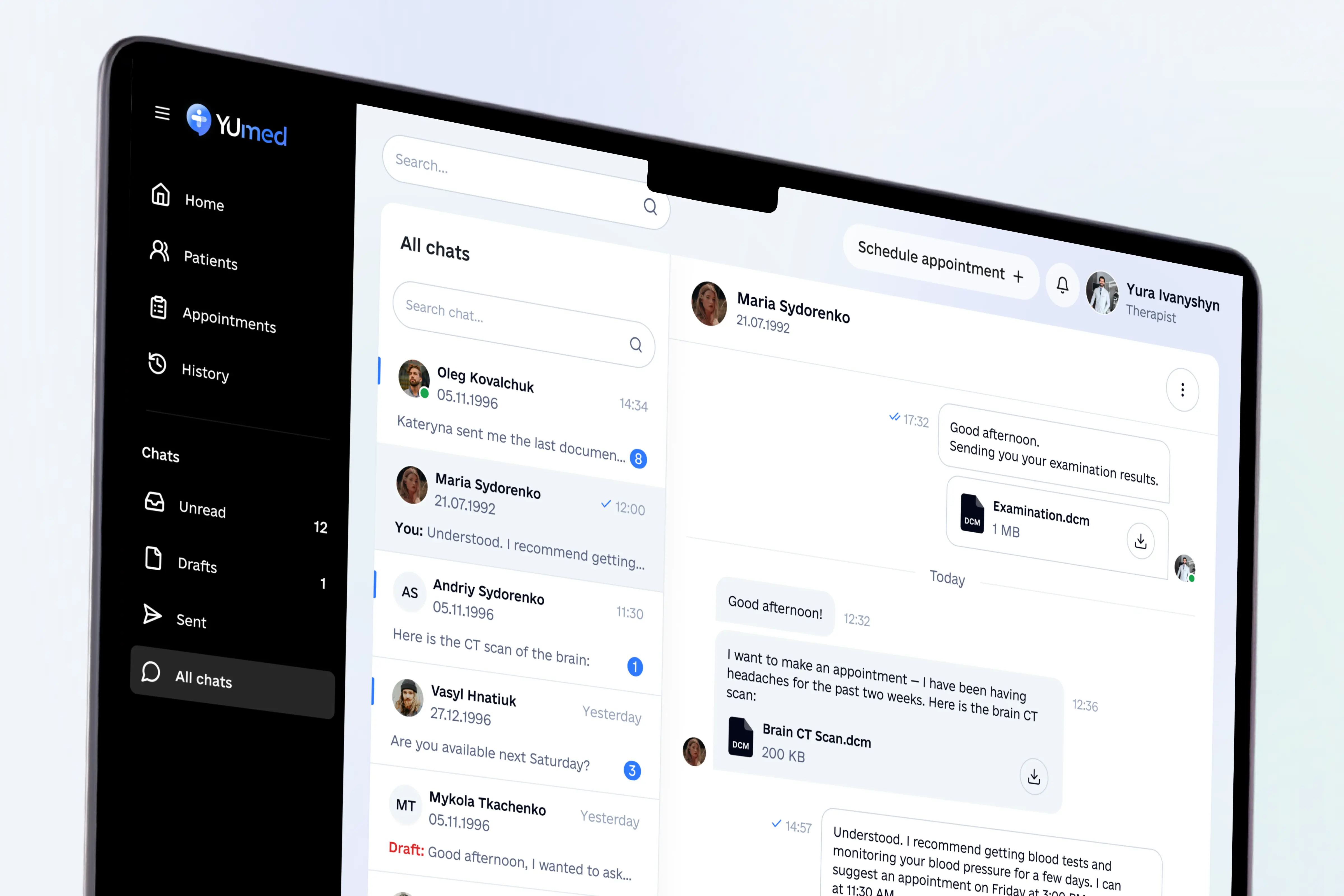
- Diagnostic Centers (Clinics): They have a maximally simplified web interface. Their task is to upload heavy files directly to the patient's record after an examination (instead of burning it to a disk).
- Patients: They receive secure cloud storage for PDF documents and high-quality scans to share with medics.
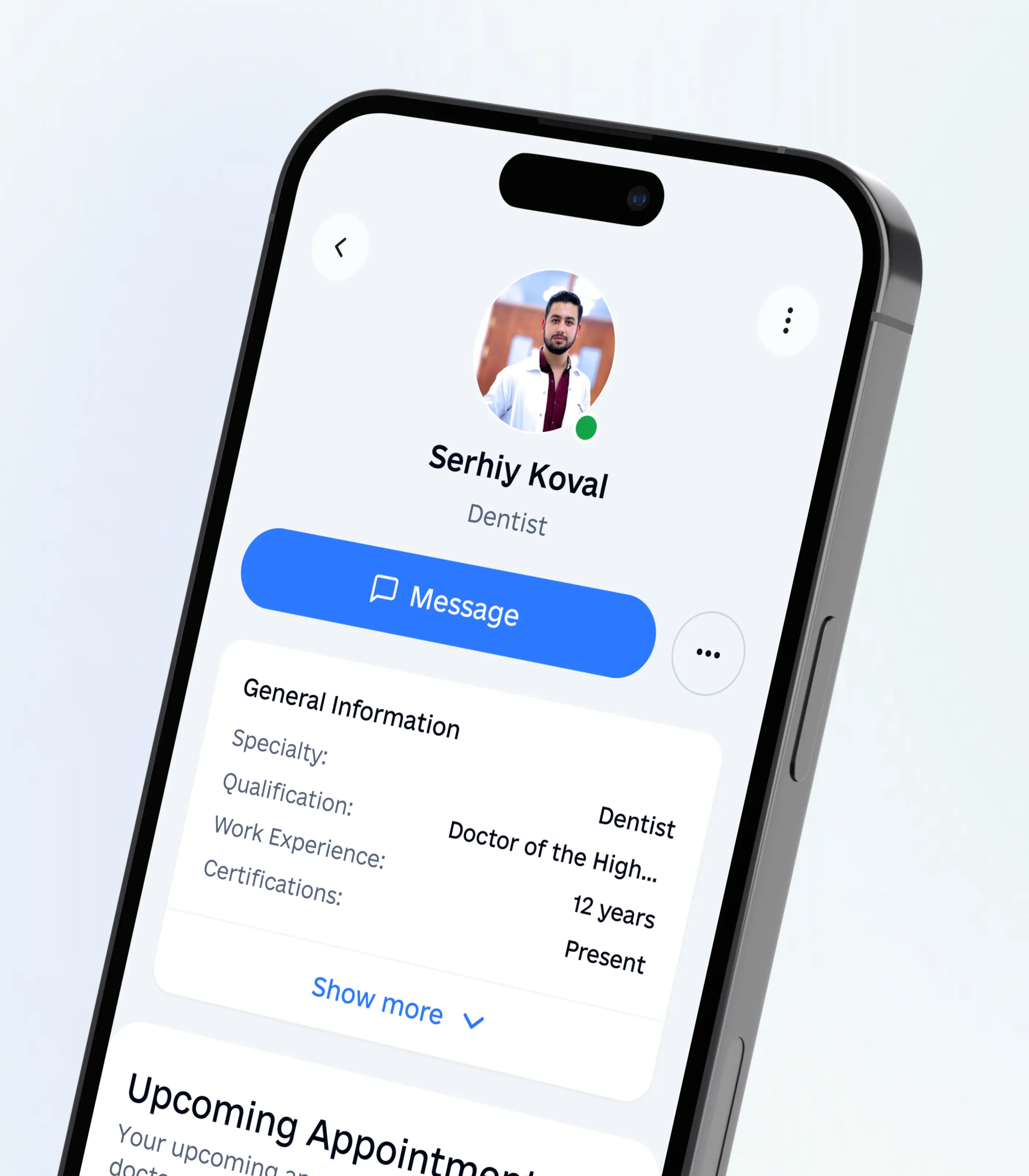
- Doctors (Private Practice): Besides the DICOM viewer, doctors get a powerful telemedicine tool. To avoid double-booking, the system automatically synchronizes patient appointments with the doctor's personal calendars (Google Calendar and Outlook).
Convenience and Uncompromising Security
In the medical field, protecting patient data (according to HIPAA/GDPR standards) is an absolute priority. YU-Med offers an ecosystem where the patient is the rightful owner of their medical information.
We implemented an advanced Patient-Centric Granular Access Control system that resolves key privacy issues:
- Timer-based Access: A patient doesn't just "share" a file. They grant the doctor access for a strictly defined period (1 day, 1 week, 6 months). Once the timer expires, the system automatically revokes the doctor's right to view the medical record.
- Audit Trail: The patient sees a detailed history: exactly which doctor viewed their record, which file was opened, and exactly when it happened.
- End-to-End Encryption (E2EE) in Chats: All medical consultations and correspondence are protected. The chat features modern functionality: typing indicators, read receipts, and a local message queue for offline sending.
- Integration with Diia: Diia is the Ukrainian state-managed digital ecosystem that provides verified, legally recognized digital identities and credentials. By integrating with the Diia API, YU-Med leverages a secure, government-backed infrastructure to instantly verify a doctor's professional licenses, replacing slow manual verification with an automated, tamper-proof digital handshake.

Best Practices and Conclusion
Working on a MedTech product is never easy. The application's architecture experienced colossal strain when attempting to transfer gigabytes of data through the built-in messenger.
The creation of YU-Med proved that even the most conservative medical processes can be optimized using mobile technologies. The product combined the speed of modern messengers, the convenience of cloud technologies, and a professional clinical toolkit, secured to the highest standards.
Business Model and Growth Loop
We were tasked with making YU-Med not just a medical service, but a self-sustaining business. Platform monetization is built on a multi-tiered subscription system (payment processing via LiqPay) with a free trial period.
To organically attract new users, we developed a gamified referral system:
- Users generate unique invitation links (valid for 72 hours).
- If an invited friend purchases a subscription, the initiator automatically gets a free month of usage.
- The system features a special "Referral Dashboard" where users can track the status of their invitations (Invited > Registered > Bonus Awarded).
Key insights (Best Practices) for B2B/B2C medical products:
- Don't reinvent the wheel. Using proven open-source libraries (like OHIF) saves time and budget, allowing a focus on integration quality.
- Security as a marketing advantage. Implementing the HIPAA standard, transparent audit logs, and integration with "Diia" are critical selling points for attracting clinics and doctors.
- Soft Launch and intensive QA. Testing specific heavy formats requires twice as much time. A closed beta release is the only safe way to preserve a product's reputation before a wide market launch.
.webp)
.avif)
.webp)
.webp)